Home › Guides › Starter not rising

Sourdough Starter Not Rising? Here's Why, and the Fix
Nearly every stalled sourdough starter has one of three causes: it is young, it is cold, or it is hungry. A young starter (days 3 to 7) just needs more time and daily feedings; the quiet stall after the day 2 or 3 boom is a normal phase, not a failure. A cold starter needs warmth: fermentation slows sharply below about 20°C (68°F), and moving the jar to a 74–76°F (23–24°C) spot often revives it within a day. A hungry starter, one that rises and collapses long before the next feeding or shows gray liquid on top, needs bigger or more frequent meals, such as moving from a 1:1:1 ratio to 1:2:2 or 1:5:5. A flat, quiet starter is the most common sourdough panic, and it is almost never dead. Here is how to tell which problem you have.
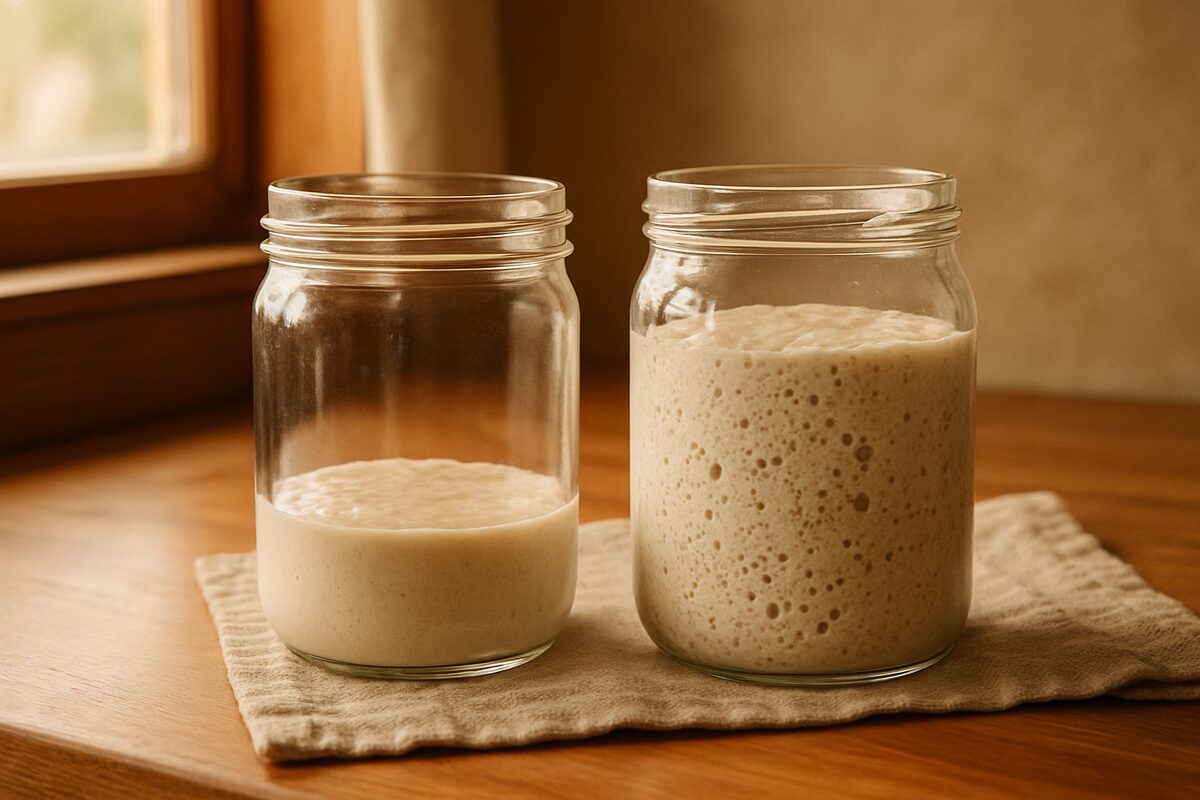
Is my starter too young? (days 3 to 7)
New starters famously boom on day 2 or 3 and then go silent. That early rise comes from bacteria that fade before the true sourdough yeast establishes itself. The stall between roughly day 3 and day 7 is a phase, not a failure, and it is so common that The Perfect Loaf's starter guide flags it as the point where most beginners wrongly assume they failed.
Fix: nothing fancy. Keep the daily discard-and-feed rhythm and keep it warm. Activity returns within a few days.
Day by day: what a new starter should be doing
Most panic about a flat starter happens on a specific day, so here is what each stage normally looks like. A new starter is not late until roughly day 14.
| Day | What is normal | What to do |
|---|---|---|
| 1 to 2 | Little or nothing. Maybe a few bubbles. | Feed daily. Nothing is wrong. |
| 2 to 3 | Often a dramatic rise, sometimes doubling. | Enjoy it, but do not bake. This is bacteria, not yeast. |
| 3 to 7 | Silence. The early rise stops, the jar looks dead, the smell turns sharp or cheesy. | Nothing. This is the stall everyone hits. Keep feeding daily and keep it warm. |
| 7 to 10 | Small, even bubbles return. A modest rise, often 25 to 50 percent. | Keep feeding. Consider adding a spoonful of rye or whole wheat. |
| 10 to 14 | Reliable doubling starts, on a predictable schedule. | Once it doubles within 4 to 8 hours twice in a row, it is ready to bake with. |
| 14+ | Still zero bubbles ever. | Now troubleshoot: warmer spot, and switch part of each feed to rye or whole wheat. |
Two details catch people out. The day 2 boom is a false start, and baking on the strength of it almost always gives a dense brick. And a cold kitchen stretches every row in this table, so a winter starter running a week behind is not a failed starter.
Why is my starter not rising after feeding?
An established starter that suddenly does nothing after a feed is usually one of four things, in rough order of likelihood:
- You missed the peak. In a warm kitchen a strong starter at 1:1:1 can rise and fall back within 4 hours. If you check 8 hours later it looks flat because it already did the work. Mark the jar with a rubber band right after feeding and check sooner, or use a bigger ratio so the cycle takes longer.
- It is cold. The same jar that doubled in 5 hours in August can take 12 or more in an unheated winter kitchen.
- The ratio outgrew it. Jumping straight to 1:10:10 with a young or weakened starter dilutes it so far that it cannot get going. Step back to 1:2:2 until the rise is reliable.
- It is still recovering. A jar just out of weeks in the fridge often needs two or three feeding cycles at room temperature before it performs again. One flat feed after the fridge means nothing.
Is my starter too cold?
Fermentation slows sharply below about 20°C (68°F). At 74–76°F (23–24°C) a healthy starter is dramatically livelier than the same jar on a cold countertop.
Fix: move the jar somewhere warm: on top of the fridge, near a router, or in the oven with just the light on. Warm (not hot) water for feeds helps too.
Is my starter underfed?
If the starter rises and collapses long before you feed again, or shows a layer of gray liquid (hooch), it is running out of food. An exhausted starter gets acidic, and acid slows the yeast further.
Fix: feed more, or more often. Move from 1:1:1 (starter:flour:water by weight) to 1:2:2 or even 1:5:5, or add a second daily feeding. A couple of days of generous meals usually restores the bounce.
Quick diagnostic: symptom, cause, and fix
Read the jar rather than the calendar. Match what you can actually see to the cause, and the fix follows from it.
| Symptom | Likely cause | Fix |
|---|---|---|
| Bubbles but no rise | Young or cold | Keep feeding daily and move the jar somewhere warm (74–76°F / 23–24°C). |
| Rise-then-collapse with liquid on top | Hungry | Feed more or more often: move to 1:2:2 or 1:5:5, or add a second daily feeding. |
| No bubbles at all after 10+ days | Cold spot plus weak flour | Add some rye or whole wheat at each feeding and find a warmer spot. |
Is it ever actually dead?
Almost never. A weak starter is also the first thing to rule out when a loaf bakes dense. Pink or orange streaks or fuzzy mold mean start over. Anything else, including weeks of neglect in the fridge, can be revived with a few warm, generous feedings.
Frequently asked questions
How long should I wait before giving up on a starter that will not rise?
At least 14 days of consistent daily feeding in a warm spot. Most stalled starters are simply young; the quiet phase between day 3 and day 7 is normal, and colder kitchens stretch every stage. Only pink or orange streaks or fuzzy mold justify starting over.
Does changing flour help a starter that is not rising?
Often, yes. Swapping a spoonful of your usual flour for rye or whole wheat at each feeding adds wild yeast and nutrients, which is especially effective when a starter shows no bubbles at all after 10 or more days.
Can chlorinated tap water stop a starter from rising?
Heavily chlorinated or chloraminated water can slow a young starter, though it rarely stops an established one. If your tap water is strongly treated, use filtered water or let tap water sit out for a few hours before feeding.
How much should my sourdough starter rise?
A healthy, established starter should roughly double between feedings, and a strong one can even triple. Mark the jar level right after feeding with a rubber band so you can see it clearly. A young starter that only rises a little is usually normal; if an established starter suddenly barely moves, it is likely too cold or overdue for a bigger feed.
Why does my starter rise and then fall?
Rising and then falling is normal: the starter hit its peak, ran through its food, and is now collapsing back down and getting hungry. You just missed the peak window. Feed it sooner, before it collapses, or use a bigger ratio like 1:5:5 so the cycle lasts longer and the peak lands when you can actually use it.
My starter was rising fine and suddenly stopped. What changed?
Something in the environment almost always changed, not the starter. The usual culprits are a colder room (a cold snap, or moving the jar to a different counter), a new bag or brand of flour, or a feeding ratio that crept up as you started discarding less. Put it back in a 23 to 24 °C (74 to 76 °F) spot, feed 1:2:2 for two or three days, and it normally returns.
My starter is runny and will not rise. What does that mean?
Runny, soupy texture with no rise almost always means hungry rather than dead. As a starter exhausts its flour, the gluten breaks down and the mixture thins out and separates, often with hooch on top. Stir it, discard down to a spoonful, and feed at 1:2:2 or 1:5:5. If it is runny because the hydration is simply high, thicken the feed by using a little more flour than water.
My starter has hooch but is not rising. Which problem is it?
Both, and they share a cause. Hooch is the alcohol a starter produces once it has run out of food, so a jar with hooch and no rise is a hungry jar that has gone acidic, and that acidity slows the yeast further. Pour the hooch off or stir it in, discard down to a couple of spoonfuls, and feed generously twice a day for two or three days. Our hooch guide covers the smell and color variations.
My starter came out of the fridge and will not rise. Is it dead?
Very unlikely. A cold starter is dormant, not dead, and wild yeast survives weeks of neglect. Give it two or three feeding cycles at room temperature before judging it: the first feed after the fridge is often flat, the second shows bubbles, and the third usually doubles. Feed with lukewarm water, around 27 to 30 °C (80 to 86 °F), to speed the wake-up, but stay below about 40 °C (104 °F) or you will start harming the microbes.
How do I fix a sourdough starter that will not rise?
Give it warmth and consistent feeding, then rule out the three causes in turn: young (days 3 to 7, just keep feeding daily), cold (move it to a 74–76°F / 23–24°C spot), or hungry (feed a bigger ratio like 1:2:2 or 1:5:5, or add a second daily feed). Two or three warm, generous cycles revive almost any starter.

Not sure which cause is yours?
Snap a photo in Sourdoughy and the AI reads rise, bubble structure, and hooch, then tells you which of the three causes it sees and exactly what to feed next.
Download Sourdoughy free