Home › Guides › Dense or gummy

Why Is My Sourdough Dense or Gummy?
A dense, tight, cakey crumb almost always means the loaf was under-fermented: bulk fermentation ended before the dough had risen about 50 percent, or the starter was too weak to lift it. A gummy, sticky, streaky crumb in a loaf that spread flat means the opposite, over-fermentation, where the gluten broke down before the dough hit the oven. A third case looks like neither: a well-risen loaf that is gummy only in a band near the base was either underbaked or sliced while still hot. Read the crumb before you change anything, because the fix for one problem makes the other worse. This guide takes each cause in turn, from the starter through the bake, and ends with the single most common mistake, which is cutting the loaf too early.
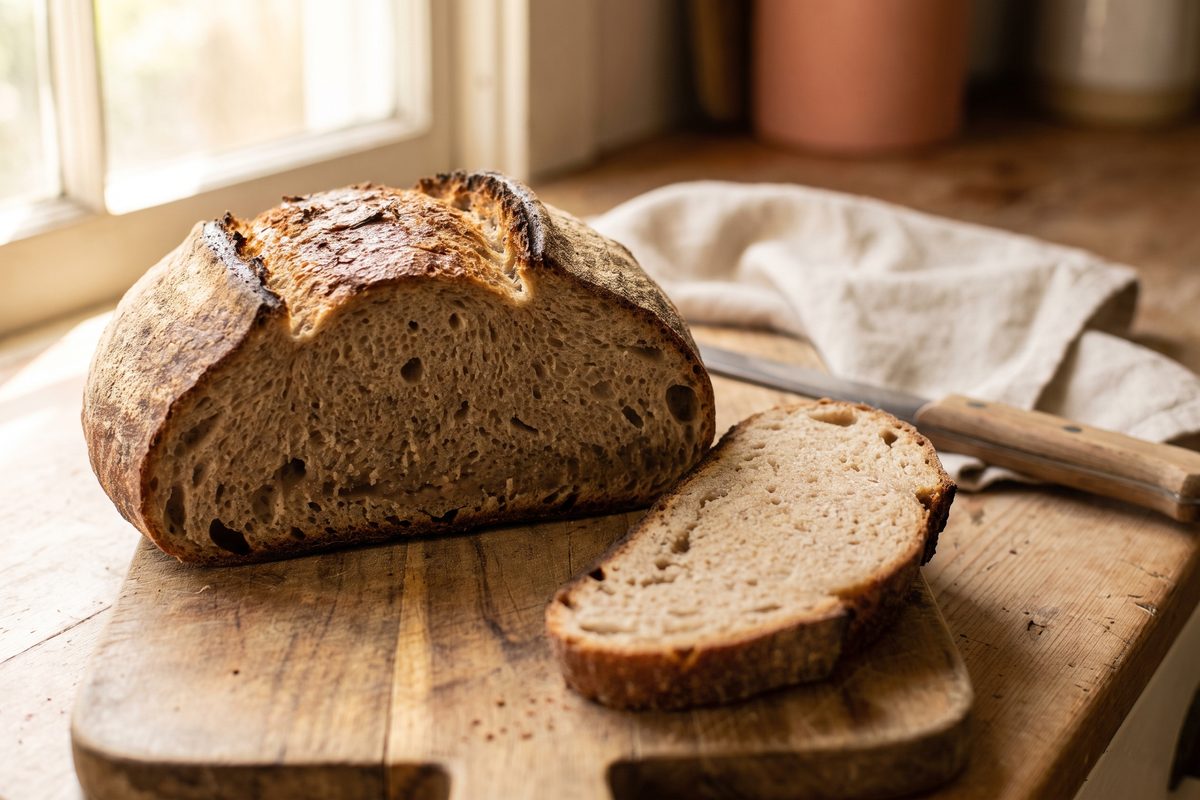
Read the crumb first
Your loaf is already telling you what went wrong. Match what you see to the cause before you change a single variable:
| What the crumb looks like | Most likely cause | First fix to try |
|---|---|---|
| Tight and even all over, cakey, few large holes | Under-fermented, or a weak starter | Longer bulk, and a starter that doubles reliably |
| Sticky and gummy throughout, loaf spread flat | Over-fermented | Shorter bulk, cooler dough |
| Good height, gummy band near the bottom crust | Underbaked, or sliced too early | Bake to 96 to 99 °C (205 to 210 °F), cool fully |
| Tall but tight, with a pale crust | Oven too cool, or no steam | Hotter Dutch oven, lid on for the first 20 minutes |
| Dense and heavy with whole grain flour | Too much whole grain for the hydration | Start at 20 to 30 percent whole grain |
Is your starter strong enough?
A weak or young starter cannot lift a loaf, however good the rest of your process is. Before you blame technique, check that yours reliably doubles in 4 to 8 hours at room temperature, around 21 to 24 °C (70 to 75 °F), and that you are using it at peak, domed and bubbly, rather than after it has collapsed.
If it is sluggish, feed twice a day at 1:5:5 for three to five days and keep it warm. A vigorous starter fixes more density problems than any shaping trick. Our guide on when a starter is ready to bake with covers the tests in detail.
Under-fermented: the tight, cakey brick
If the crumb is dense and even throughout with few large holes, bulk fermentation ended too soon. The dough needs to rise roughly 50 percent and to feel alive: jiggly, domed, and showing bubbles at the edges of the container.
Dough temperature matters far more than the clock here. A kitchen below 21 °C (70 °F) can add hours you did not plan for, which is why a recipe that worked in July gives you a brick in January. Track the dough, not the timer, and use the poke test to confirm: press a floured finger about 1 cm into the dough, and if the dent springs back slowly and only partway, it is ready.
Over-fermented: the gummy, flat loaf
A loaf that spread sideways with a slack, sticky, gummy crumb full of small dense bubbles went too far. The gluten broke down before it could hold gas in the oven, and this is the most common cause of a genuinely gummy interior.
Shorten bulk fermentation, or move the dough to the fridge sooner for its cold proof, and keep the dough cooler: aim for roughly 24 to 25 °C (75 to 77 °F) rather than the high twenties. When you are unsure, err on the side of under-fermenting. A slightly young loaf bakes better than an exhausted one.
Weak gluten and too much water
Dough that never built strength cannot trap gas, so it bakes low and tight no matter how long it fermented. Develop the gluten with a proper mix plus three to four sets of stretch and folds in the first one to two hours, until the dough turns smooth, stretchy and passes a gentle windowpane test.
If you are new, dial the hydration back to 65 to 70 percent. A slack 80 percent dough is much harder to strengthen and shape, and it punishes small mistakes. Whole grain and rye flours also drink more water and weigh the crumb down, so start at 20 to 30 percent whole grain rather than a full wholemeal loaf.
Shaping with no surface tension
A poorly shaped loaf slumps sideways instead of rising upward, which gives you a wide, flat, dense result even when fermentation was fine. Shape on a lightly floured counter, dragging the dough toward you to build a taut skin, then proof it seam side up in a floured banneton so it holds a domed structure.
If the dough feels like a puddle you cannot tension at all, that is usually a hydration or over-fermentation signal rather than a technique problem. Our shaping guide walks through the boule and batard step by step.
The bake: heat, steam, and doneness
Sourdough needs a hot, steamy start to spring before the crust sets. A cool or dry oven kills the rise and leaves you with a pale, tight loaf.
- Preheat the Dutch oven to 245 to 260 °C (475 to 500 °F).
- Bake covered for the first 20 minutes so the loaf makes its own steam.
- Uncover and finish at 220 to 230 °C (425 to 450 °F) until deep brown.
- Pull it only when the internal temperature reaches 96 to 99 °C (205 to 210 °F).
An underbaked center stays gummy no matter what you did earlier, and crust color alone will fool you. A thermometer removes the guesswork entirely.
Did you slice it too early?
This is the one that catches almost everybody. The crumb is still setting as the loaf cools, and cutting into a hot loaf lets steam escape through the cut face, leaving the interior feeling wet and gummy even when the bake was perfect.
Cool the loaf fully on a wire rack for at least one to two hours before slicing. For a large or heavily whole grain loaf, longer is better. If your bread seems gummy fresh from the oven but fine the next morning, cooling was the whole problem.
Frequently asked questions
Why is my sourdough gummy in the middle?
Either it was over-fermented, underbaked, or sliced too early. If the loaf also spread flat and the crumb is sticky throughout, it over-fermented. If the loaf rose well and only a band near the base is gummy, it was underbaked or cut hot. Bake to an internal 96 to 99 °C (205 to 210 °F) and cool for at least one to two hours before slicing.
Why is my sourdough so dense and heavy?
Most often the bulk fermentation ended too early or the starter was not strong enough to lift the dough. The dough should rise about 50 percent during bulk and feel jiggly and domed, and the starter should double within 4 to 8 hours of feeding. A cold kitchen is the usual hidden cause, because it adds hours that the recipe did not account for.
Can you fix a dense sourdough loaf after baking?
Not really, the crumb is set. But the loaf is still good food: dense sourdough makes excellent toast, croutons, French toast, breadcrumbs and panzanella, where the tight crumb is actually an advantage. Fix the cause on the next bake rather than trying to rescue this one.
Is a gummy crumb caused by too much water?
High hydration makes every other mistake harder to recover from, but on its own it does not make bread gummy. A well-fermented, well-baked 80 percent dough is not gummy. If you are troubleshooting, dropping to 65 to 70 percent hydration is still worth doing, because it makes the dough easier to strengthen and shape while you fix the real cause.
How do I know if my dough is under-fermented or over-fermented before baking?
Use the poke test at the end of proofing. Press a floured finger about 1 cm into the dough. If it springs back fast and completely, it needs more time. If it springs back slowly and only partway, it is ready. If the dent stays put and the dough feels slack and sighs, it has gone too far, so bake it now and shorten bulk next time.
Why is my sourdough dense with whole wheat flour?
Whole grain flours absorb more water and their bran cuts gluten strands, so the same recipe bakes denser. Increase hydration slightly, keep whole grain to 20 to 30 percent of the total flour while you are learning, and expect a tighter crumb than a white loaf even when everything goes right.

Photograph the crumb, get the diagnosis
Sourdoughy logs each bake with a photo, so you can compare this crumb against your last one and see which change actually helped. The dense bread tutorial walks through every cause in the app.
Download Sourdoughy free