
When Is My Sourdough Starter Ready to Bake With?
A sourdough starter is ready to bake with when it doubles reliably within 4 to 8 hours of a feeding. Look for four signs together: a consistent doubling in volume, a bubbly and airy texture throughout the jar, a domed (not flat or sunken) top, and a pleasantly tangy smell like yogurt rather than nail polish. Most starters reach this point between day 7 and day 14 of daily feeding; kitchens colder than about 20°C (68°F) take longer. Readiness is a behavior, not a date: a starter that doubled once on day 5 but cannot repeat it is not ready, while one that doubles on schedule three days in a row is. The popular float test, dropping a spoonful in water to see if it floats, is unreliable because a stirred or over-fermented starter can sink while still being perfectly ready. Baking with an unready starter is the number one cause of dense, flat first loaves.
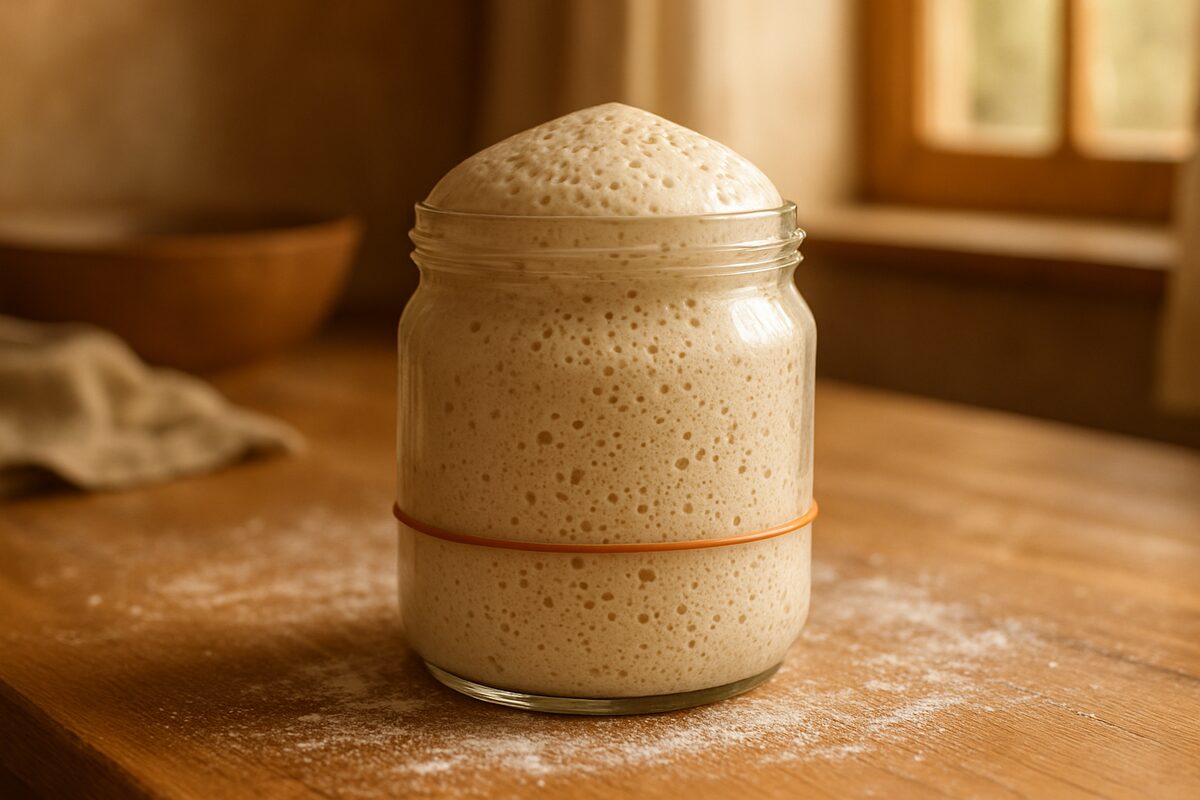
What are the four real readiness signs?
- Reliable doubling: the starter at least doubles within 4–8 hours of a feeding, and does it consistently for several days in a row.
- Bubbles throughout: not just surface froth, but bubbles visible through the jar walls, top to bottom.
- A domed (or just-flattening) top: a dome means still rising; the peak is the ideal baking window. A collapsed, sunken top means you missed it, feed and catch the next peak.
- A pleasant tang: yogurt-sour, mildly fruity. A sharp acetone or nail-polish smell means it is overdue for a feed, not ready.
Why is the float test unreliable?
Dropping a spoonful in water to see if it floats is popular, but unreliable in both directions: a stirred or wet starter can sink while perfectly ready, and rye-heavy starters may never float at all. Treat floating as a bonus signal, never the deciding one. Experienced bakers like The Perfect Loaf lean on rise behavior, texture, and smell for the same reason.
When should I mix my dough?
Mix your dough when the starter is at or just before peak: domed, bubbly, aromatic. If it peaked hours ago and fell, give it one more feeding and bake on the next cycle. For morning mixing, feed the night before with cooler water or a bigger ratio so the peak lands after breakfast.
Frequently asked questions
How long after feeding is a starter ready to use?
Typically 4 to 8 hours after a feeding, when it reaches its peak: doubled in volume, domed on top, and bubbly throughout. In a cold kitchen the peak can take longer, and with a bigger feeding ratio like 1:5:5 it arrives later.
Can a starter be ready on day 5?
Rarely. A single strong rise on day 5 is usually the early bacterial boom, not stable yeast. Readiness means the starter doubles on schedule several days in a row, which most starters only manage between day 7 and day 14.
What if my starter passed the float test but my bread came out dense?
The float test only measures trapped gas at one moment, so an over-fermented or one-hit-wonder starter can float and still lack the strength to raise a loaf. Judge readiness by repeated doubling within 4 to 8 hours over several days, not by floating.
Does a sourdough starter have to float to be ready?
No. A well-fed, ready starter can still sink, especially if it is high-hydration, rye-heavy, or stirred before the test, so a failed float does not mean it is not ready. Judge it by whether it doubles within 4 to 8 hours, is bubbly throughout, domed on top, and smells tangy. Floating is at best a bonus clue, never the deciding one.
How do I test if my sourdough starter is ready?
Skip the float test and watch behavior instead. Mark the jar level right after feeding with a rubber band, then check that it at least doubles within 4 to 8 hours, shows bubbles top to bottom through the glass, holds a domed top at peak, and smells like tangy yogurt rather than nail polish. When it does that three days running, it is ready.
When is a starter ready to bake with?
A starter is ready to bake with once it doubles within 4 to 8 hours of a feeding, looks domed and bubbly at its peak, and smells pleasantly tangy. Most starters reach this between day 7 and day 14 of daily feeding, and colder kitchens take longer. Mix your dough at or just before that peak for the strongest rise.

Let AI call the baking window
Photograph your jar and Sourdoughy tells you whether your starter is at peak, still climbing, or past it, so you mix dough at the moment it will raise bread best.
Download Sourdoughy free