
How to Shape Sourdough: Boule and Batard
Shaping is what turns a fermented blob into a loaf that rises upward instead of spreading sideways. It happens in two stages: a loose pre-shape and a 20 to 30 minute bench rest to relax the gluten, then the final shape, where you build a taut skin around the dough. For a boule you cup your hands behind the ball and drag it toward you across bare counter, rotating a quarter turn each time. For a batard you fold the dough like a letter and roll it into a tight log. Either way the goal is the same: a smooth, tight outer skin that traps gas. The loaf then goes seam side up into a rice-floured banneton for its proof.
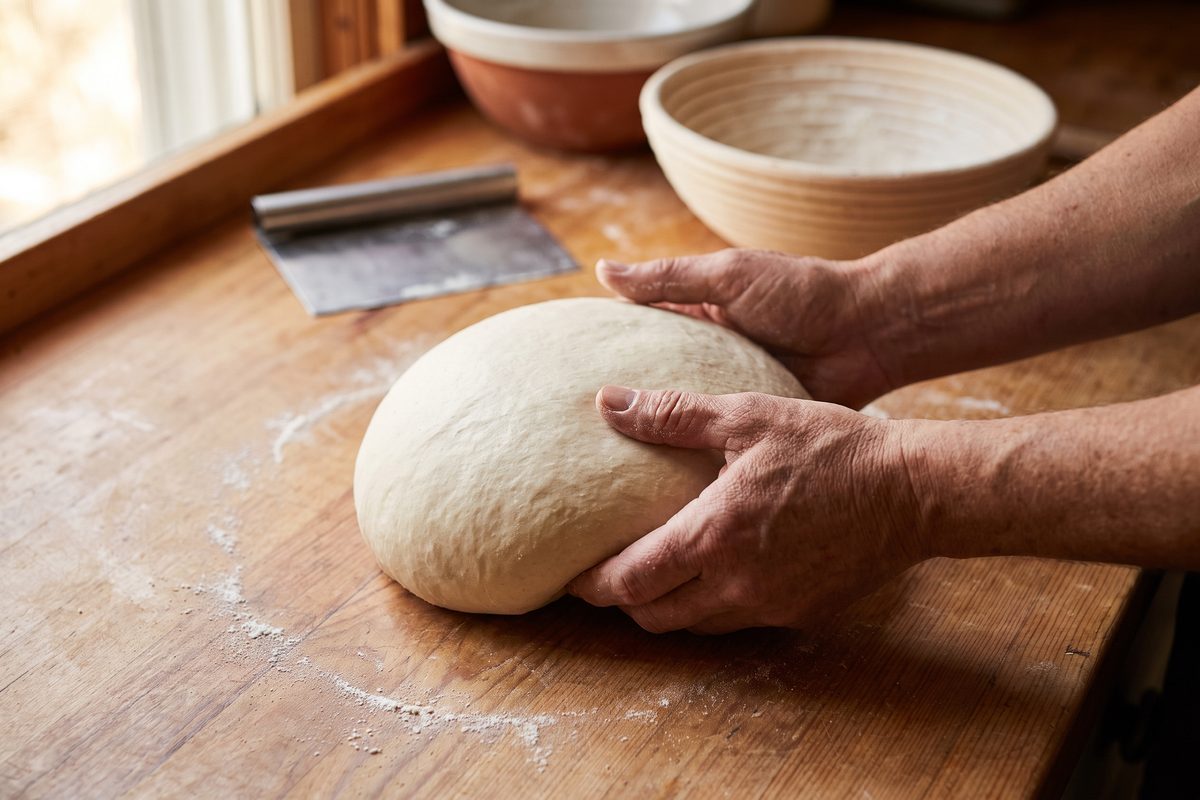
Pre-shape and bench rest
Once bulk fermentation looks domed and jiggly, tip the dough out and gently round it into a loose ball with a bench scraper. Do not fight it or build real tension yet; this is just organising the dough.
Let it sit uncovered on the counter for 20 to 30 minutes. This is the bench rest, and it relaxes the gluten so the final shape goes smoothly instead of the dough fighting back and tearing. Keep it under 30 minutes: much longer and the dough spreads out and loses the structure you just gave it.
How to shape a boule (round)
A boule is the easier of the two shapes and the better one to learn on.
- Flip the pre-shaped ball so the smooth side faces up.
- Cup your hands behind the dough.
- Drag it toward you across an unfloured patch of counter.
- Rotate a quarter turn and repeat, four or five times around.
The slight grip of the bare surface is doing the work: it pulls the skin tight into a smooth, taut dome. That tension is what traps the gas and gives you a tall round rise instead of a flat spread. Flour on the counter at this stage is the most common reason a boule will not tighten, because the dough just slides.
How to shape a batard (oval)
A batard takes a little more handling but slices beautifully for sandwiches.
- Gently pat the dough into a rough rectangle, smooth side down.
- Fold it like a letter: left third into the middle, then right third over that.
- Roll it up from the top into a taut log.
- Seal the seam with the heel of your hand.
- Cup your hands around the log and roll it a few times to even the tension end to end.
A batard rewards a tight seam and a smooth top, because that top is where your score will open up.
Into the banneton
Dust the banneton generously with rice flour, which resists moisture far better than wheat flour and keeps the dough from gluing itself to the basket. Do not be shy with it; a clean release starts here.
Place the shaped loaf seam side up, so the smooth side presses into the basket and picks up the spiral pattern. When you turn it out onto parchment before baking, the seam ends up on the bottom and the pretty surface faces the blade.
No banneton? A mixing bowl lined with a well-floured tea towel does the same job, though you will not get the ring pattern.
How do I know the shape is tight enough?
Look for three things right after shaping:
- The surface is smooth and slightly taut, not wrinkled or slack.
- The ball holds a domed shape for a minute or two instead of flowing outward immediately.
- You can pick it up with a bench scraper without it collapsing.
If the dough spreads into a puddle the moment you stop touching it, the problem is usually not your hands. It is over-fermentation or hydration that is too high for your flour, both covered in the dense and gummy guide.
Common shaping mistakes
- Flouring the counter for the final shape. The dough needs grip to build tension. Flour the counter for the pre-shape if you like, but shape on a bare patch.
- Skipping the bench rest. Shaping straight after pre-shaping means fighting tight gluten, and the dough tears.
- A bench rest that runs long. Past about 30 minutes the dough relaxes too far and you lose the structure.
- Tearing the skin. Once torn, that surface cannot hold gas. Work gently and accept slightly less tension rather than ripping it.
- Too little rice flour in the basket. A loaf that sticks and deflates on the way out cannot be saved.
Frequently asked questions
How long should the bench rest be between pre-shape and final shape?
Twenty to thirty minutes. That is long enough for the gluten to relax so the final shape goes smoothly, and short enough that the dough has not spread out and lost structure. If your kitchen is very warm, stay at the shorter end.
Should I shape sourdough on a floured surface?
Not for the final shape. The dough needs to grip the counter so that dragging it builds surface tension, and flour makes it slide instead. Use a bare, clean patch of counter for shaping. You can lightly flour the surface for the pre-shape, when you are not yet building tension.
Do I need a banneton to shape sourdough?
No. A mixing bowl lined with a well-floured tea towel holds the shape just as well; you simply miss out on the spiral ring pattern. Whatever you use, rice flour resists moisture much better than wheat flour and is the difference between a clean release and a deflated loaf.
Seam side up or seam side down in the banneton?
Seam side up. The smooth side presses into the basket, and when you tip the loaf out onto parchment the seam ends up underneath and the smooth surface faces up, ready to score. If you proof seam side down you will score the seam instead.
Why does my dough spread flat after shaping?
Usually over-fermentation, hydration too high for your flour, or a skin that tore during shaping. Tension can only hold if the gluten is still intact, so a dough that has gone too far in bulk will not hold any shape no matter how well you handle it. Shorten bulk fermentation and try 65 to 70 percent hydration.
What is the difference between a boule and a batard?
A boule is round and a batard is an oval, more like a short torpedo. A boule is shaped by dragging the ball across the counter to tighten the skin; a batard is folded like a letter and rolled into a log. Boules are more forgiving for beginners; batards give you more even slices for sandwiches.
Know exactly when to shape
Sourdoughy times your bulk fermentation and rings you when the dough is ready to pre-shape, so you are not guessing from the clock while the dough quietly over-ferments.
Download Sourdoughy free