Home › Guides › Stretch & fold

Stretch and Fold: the Gentle Way to Strong Sourdough
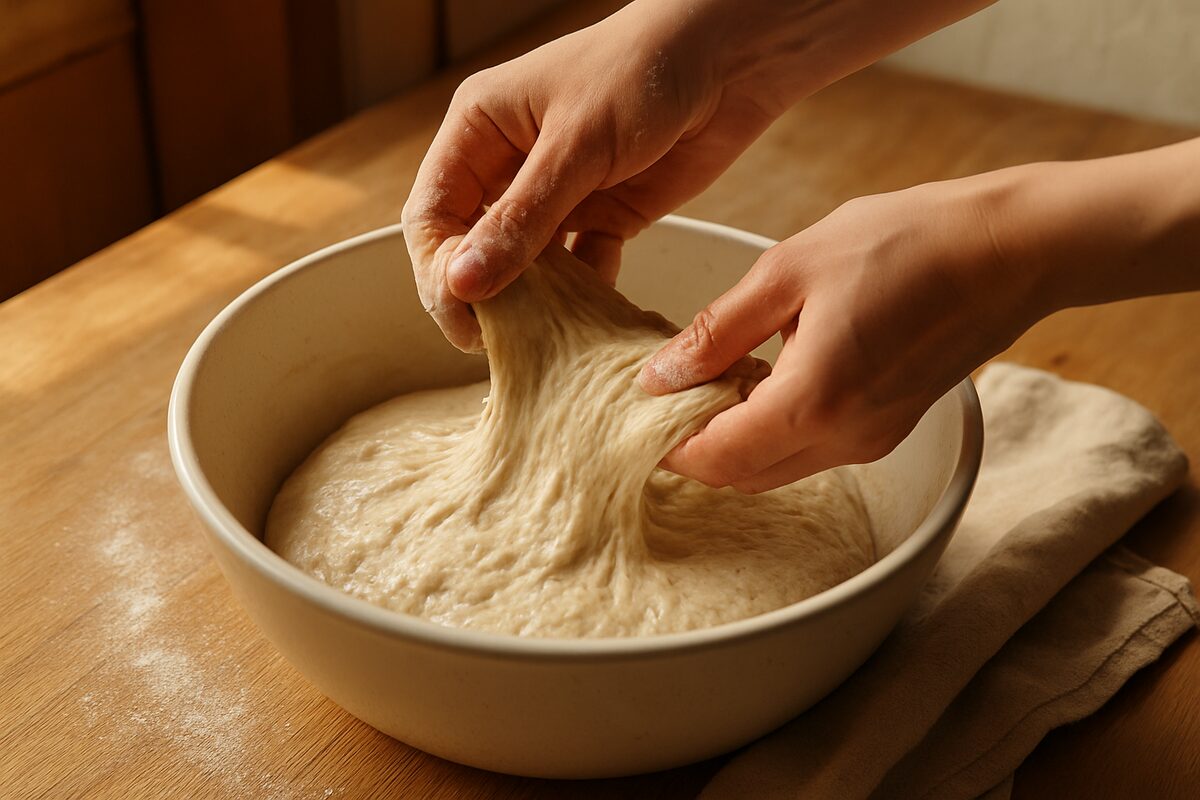
Stretch and folds replace kneading in sourdough baking. With a wet hand, you stretch one edge of the dough upward until you feel resistance, fold it over the top, rotate the bowl a quarter turn, and repeat four times: that is one set. Most doughs need 4 sets, spaced about 30 minutes apart, starting 30 minutes after mixing. Each set takes about twenty seconds, so the whole technique costs under two minutes of actual work spread across the first two hours of bulk fermentation. Slack, wet doughs benefit from an extra set or two, while stiff doughs may need only three. You stop when the dough holds its shape, looks smooth and slightly glossy, and springs back when gently stretched. After the last set, leave the dough completely undisturbed for the rest of bulk fermentation, because that stillness is when the open crumb develops.
Why fold instead of knead?
Sourdough is usually mixed at 70 to 85 percent hydration, which is far too wet and sticky to knead on a counter the way you would a sandwich loaf. Folding builds the same strength in place. Each set aligns the gluten strands and traps the gas that fermentation is already producing, and the rest between sets lets the gluten relax so the next fold can stretch it a little further. The total active work is under two minutes, spread across the first two hours.
How do I do a stretch and fold set?
One set is four folds, a quarter turn apart, and takes about twenty seconds:
- With a wet hand, grab the edge of the dough on one side.
- Stretch it upward until you feel resistance (do not tear it).
- Fold it over the top of the dough ball.
- Rotate the bowl a quarter turn and repeat, four folds equal one set.
The wet hand is not optional, it is what keeps high-hydration dough from gluing itself to you and tearing.
How many sets of stretch and folds does sourdough need?
Four sets is the standard answer, and it suits most beginner recipes at around 70 percent hydration. The real number depends on how wet your dough is, because wetter dough starts slacker and needs more help to come together. Use this as a starting point rather than a rule:
| Dough | Hydration | Sets |
|---|---|---|
| Stiff, lower hydration | 65 to 70% | 3 |
| Standard beginner loaf | 70 to 75% | 4 |
| Slack, wet, high hydration | 78 to 85% | 5 to 6 |
The count matters less than the dough. Stop the moment it already resists and springs back at the start of a set, even if that happens after three. A dough that is fighting you does not need another fold, it needs to be left alone.
How long between stretch and folds?
About 30 minutes, and anywhere from 15 to 45 minutes is fine. Thirty is a convention that fits a kitchen timer, not a number the dough knows about. What actually matters is two things: the gluten gets long enough to relax between sets, and all the folding finishes in roughly the first half of bulk fermentation so the dough can then rise undisturbed.
Fifteen-minute spacing works if you want to compress the folding into a shorter window, and it is common with very wet dough that needs frequent attention early on. Beyond about 45 minutes you are into the second half of bulk, where handling the dough costs you more gas than the fold gains you in strength.
Can you do too many stretch and folds?
Yes, though it is harder than people fear, and the damage comes from when you fold rather than how many times. Folding into a dough that has already built strength and filled with gas knocks that gas back out, and you end up with a tighter, more uniform crumb instead of the open one you were after. The classic signs of overdoing it are a dough that tears rather than stretches, and a baked loaf with a dense, even texture and no irregular holes.
You will not ruin a loaf with a fifth set on genuinely slack dough. You can dull one by folding every 20 minutes for four hours because a chart told you to. Fold while the dough still feels loose, then stop.
Are stretch and folds necessary?
Not strictly. Dough develops gluten on its own through time alone, a process bakers call autolyse, and no-knead breads rely entirely on it. Skipping folds altogether gives you a slacker dough that spreads more in the oven, so you get a flatter loaf with a tighter crumb rather than a failure.
What folds buy you is structure for roughly two minutes of work: a loaf that holds its height, and a crumb with irregular holes. For a first sourdough, that difference is the one between a pleasant flat disc and something that looks like the photos.
Coil folds, slap and fold, and when to switch
Stretch and fold is one technique among several, and most bakers mix them within a single bake depending on how the dough is behaving.
- Coil fold. Gentler, for later sets once the dough is airy. Wet both hands, slide them under the middle, lift the center straight up and let both ends tuck underneath as the dough coils on itself. Set it down, quarter turn, repeat two to four times. A very common pattern is stretch and folds for the first set or two, then coil folds after that, because coils protect the gas you have already built.
- Slap and fold. Faster gluten development for stiffer dough, around 65 to 70 percent hydration. Tip the dough onto an unfloured counter, lift it with both hands, slap the far edge down and fold the near edge over. It looks alarming and sticky for the first minute, then after 3 to 6 minutes the dough turns smooth and cohesive and comes off the counter cleanly.
- Book fold. A shaping-adjacent fold where you fold the dough in thirds one way and then the other, like closing a letter. Useful as a single final fold to tighten a slack dough before pre-shaping.
How do I know my dough is done folding?
The dough tells you before the count does. Look for all three of these:
- It holds its shape in the bowl instead of slumping flat within minutes.
- The surface looks smooth and slightly glossy.
- A gentle stretch shows elasticity, the dough pulls back.
When the dough already resists and springs back at the start of a set, it has enough strength, stop folding regardless of the count.
For a definitive check after your third set, use the windowpane test: pinch off a small piece and stretch it thin between your fingers. If it stretches into a translucent membrane you can almost see light through before it tears, the gluten is developed and you are done.
Frequently asked questions
Do stretch and folds have to be exactly 30 minutes apart?
No. Thirty minutes is a convention, not a rule; anywhere from 15 to 45 minutes between sets works. What matters is giving the gluten time to relax between sets and finishing all folding in roughly the first half of bulk fermentation, so the dough can rise undisturbed afterward.
Why is my dough still slack after four sets of folds?
Usually one of three things: the hydration is very high for your flour, the flour is low in protein, or the starter was weak, so fermentation is not creating the gas that makes strength visible. Add one or two extra sets, and make sure your starter doubles reliably within 4 to 8 hours of feeding. The Perfect Loaf's starter guide is a solid reference for getting one that strong.
What if I forget one of the stretch and folds?
One missed set rarely ruins a loaf. Dough builds some strength on its own as it ferments, so just do the remaining sets when you remember. If you missed most of them, do one thorough final set and expect a slightly flatter, denser loaf rather than a failure.
How many sets of stretch and folds does sourdough need?
Usually about 4 sets, where each set is four folds a quarter turn apart. Slack, high-hydration doughs can take 5 or 6 sets, while stiff, lower-hydration doughs may need only 3. Stop counting once the dough holds its shape, looks smooth and glossy, and springs back when you stretch it, even if that happens before the fourth set.
How often should I do stretch and folds?
About every 30 minutes during the first roughly 2 hours of bulk fermentation, starting 30 minutes after mixing. Anywhere from 15 to 45 minutes between sets is fine; the goal is to space them out enough that the gluten relaxes and to finish all the folding in the first half of bulk so the dough can then rise undisturbed.
What comes after stretch and folds?
After the last set you leave the dough completely undisturbed for the rest of bulk fermentation, which is when the open crumb develops. Once bulk is done (the dough is domed, jiggly, and about 50% bigger, which takes roughly 4 to 6 hours at 24 to 26 °C / 75 to 79 °F) you shape it, proof it (often an overnight cold proof in the fridge), then score and bake in a hot Dutch oven.
How many folds are in one set?
Four. You stretch and fold one edge over the top, rotate the bowl a quarter turn, and repeat until you have gone all the way around. Those four folds together count as a single set, which is why "4 sets" means around 16 individual folds across the whole bulk, not four.
Can I do stretch and folds every 15 or 20 minutes?
Yes. Fifteen to twenty minute spacing is perfectly workable and is common with very wet dough, which benefits from more frequent early attention. The gluten simply gets less relaxing time between sets, so each fold stretches it slightly less far. Just finish all your folding within roughly the first half of bulk fermentation rather than continuing at that pace for hours.
How many stretch and folds does focaccia need?
Usually 3 to 4 sets, same as bread, despite focaccia being wetter. The difference is what happens after: focaccia is not shaped tightly, so you are only building enough strength to hold bubbles, not enough to support a tall loaf. Stop as soon as the dough comes together and holds a loose ball.
What is the difference between stretch and fold and coil folds?
A stretch and fold lifts one edge at a time and folds it over the top, which develops strength quickly but presses down on the dough. A coil fold lifts the dough from the middle and lets both ends tuck underneath, which is gentler and preserves gas. Most bakers use stretch and folds for the first one or two sets, when the dough is slack and needs real development, then switch to coil folds once it is airy.

A timer that rings for every fold
Start a bake in Sourdoughy, and it counts your sets and rings you for every stretch and fold, even with the phone locked on the counter. No more forgotten folds.
Download Sourdoughy free