
How to Score Sourdough Bread
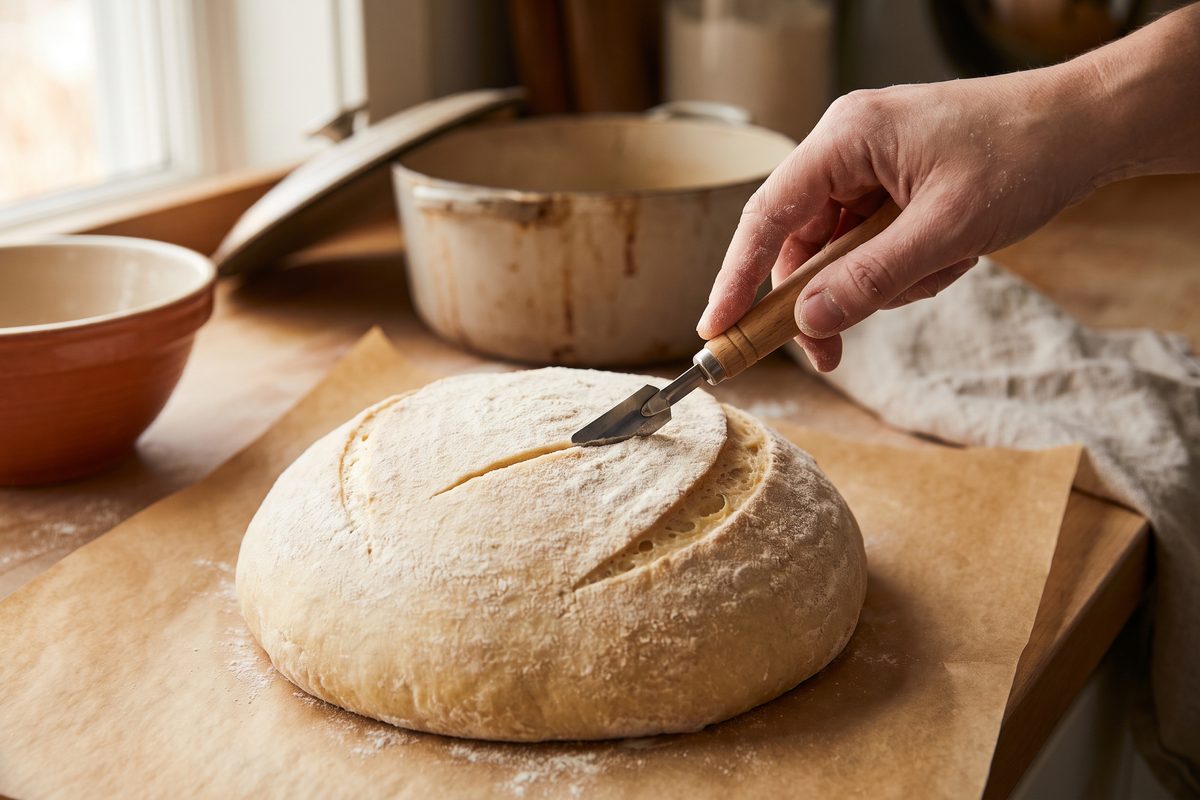
Scoring gives the loaf a controlled weak point, a place you have chosen for it to burst as it springs in the oven. Without one, steam finds its own way out and the loaf tears at random along its sides. Use a lame or a plain sharp razor, keep the blade dry, and score the loaf straight from the fridge while it is cold and firm. For an ear, that raised flap of crust, hold the blade at a shallow angle of about 30 degrees and make one long, quick slash just under the surface. For a wider, more even opening, hold the blade straight down at 90 degrees and cut deeper, around 1 cm. Speed matters more than precision: commit to one confident stroke.
Why score at all?
As the loaf hits the oven, the gas inside expands fast and the dough pushes outward. That expansion has to go somewhere. Scoring decides where.
A single deep functional cut gives the loaf one weak point, so it opens there in a dramatic bloom instead of splitting along a random seam or bursting out of the side. Scoring is structural first and decorative second, which is why one confident cut beats an elaborate pattern every time.
What should I score with?
A lame, which is a razor blade on a handle, is the standard tool and the cheapest upgrade in sourdough baking. A plain double-edged razor blade works just as well, and some bakers prefer a curved blade for ears.
What matters is that the blade is genuinely sharp and dry. A dull or damp blade drags through wet dough, sticks, and tears the surface rather than slicing it. A sharp paring knife can work at a pinch on stiffer dough, but it will not give you a clean ear. Serrated bread knives are the wrong tool entirely.
Score cold, straight from the fridge
This is the single biggest thing that makes scoring easier, and most beginners do not know it.
Cover the shaped loaf and rest it in the fridge at roughly 3 to 5 °C (38 to 41 °F) for 8 to 16 hours. The cold firms the dough so it holds its shape and does not deflate under the blade, which is exactly why cold dough scores cleanly and room-temperature dough smears and drags. This cold proof also deepens flavour and builds a thicker, more blistered crust.
Score the loaf straight from the fridge. No warming up, no resting on the counter first.
What angle should I hold the blade at?
The angle decides what kind of opening you get:
| Angle | Depth | Result |
|---|---|---|
| About 30 degrees, shallow | Just under the surface | An ear: a raised flap of crust that curls up as the loaf springs |
| 90 degrees, straight down | About 1 cm | A wide, even opening with no ear |
| 90 degrees, very shallow | 2 to 3 mm | Decorative lines that stay crisp and barely open |
For the ear, you are essentially lifting a thin flap of the skin rather than cutting a trench. One long, quick slash across the loaf, slightly off-centre, gives the most reliable result.
How deep should the cut be?
For the main functional score, about 1 cm straight down, or a shallow slice just beneath the surface if you are going for an ear. Too shallow and the loaf will find its own escape route and tear somewhere else. Too deep and you deflate the dough you spent all day building.
Decorative scores are different: keep those at 2 to 3 mm so they stay pretty and do not compete with the main cut for the expansion.
Why did my score not open?
- The cut was too shallow. The loaf found an easier exit and burst elsewhere.
- The dough was over-proofed. There was no spring left to push the score open, so it stayed a flat line. This is the most common cause.
- Too many decorative cuts. The expansion split across all of them and none opened properly.
- Not enough steam. The crust set before the loaf finished springing. Bake covered for the first 20 minutes.
- The dough was warm. A room-temperature loaf smears under the blade and the cut closes behind it.
Decorative scoring
Once you trust your main cut, you can add shallow decorative scores: wheat stalks, leaves, simple lines. Keep them shallow, 2 to 3 mm, so they stay crisp and barely open.
The rule is one deep functional cut plus whatever decoration you like. If every cut is deep, the loaf has no single weak point and none of them blooms.
Frequently asked questions
What angle do you hold a lame at for an ear?
About 30 degrees, held shallow so you are lifting a thin flap of the skin rather than cutting a trench. Make one long, quick slash slightly off-centre. Holding the blade straight down at 90 degrees gives a wide, even opening instead, with no ear.
How deep should you score sourdough?
About 1 cm for the main functional cut, or a shallow slice just beneath the surface if you want an ear. Decorative cuts should stay at 2 to 3 mm. Too shallow and the loaf tears somewhere else; too deep and you deflate the dough.
Should I score sourdough cold or at room temperature?
Cold, straight from the fridge. After an 8 to 16 hour cold proof at 3 to 5 °C (38 to 41 °F), the dough is firm enough to hold its shape under the blade instead of smearing and deflating. This is the single biggest thing that makes scoring easier, and no warming up is needed.
Why does my sourdough score not open in the oven?
Usually the dough was over-proofed and had no oven spring left to push the cut open, or the cut was too shallow and the loaf burst elsewhere. Too many deep decorative cuts split the expansion between them, and a dry oven lets the crust set before the loaf finishes rising. Bake covered for the first 20 minutes to trap steam.
Can I score sourdough with a knife instead of a lame?
A very sharp paring knife works on firmer dough, but it will not give you a clean ear, because the thicker blade drags rather than slicing just under the surface. A plain double-edged razor blade costs almost nothing and performs as well as a lame. Avoid serrated bread knives; they tear the skin.
Do I have to score sourdough bread?
Not strictly, but the loaf will still open somewhere. Unscored loaves tear at random, usually along a weak point on the side, which gives an uneven shape and sometimes a blowout. One confident cut controls where that happens and gives you a predictable, attractive bloom.

Get to the scoring step with dough worth scoring
Sourdoughy tracks the whole bake, from the fold timer through the cold proof, so the loaf that reaches your blade has the spring to open the way you scored it.
Download Sourdoughy free